Peace beyond borders

A cross-border peacebuilding and P/CVE initiative working in Uganda and the Democratic Republic of Congo

Ongoing

Uganda and DRC

What was the problem?

Violent extremism along the Uganda and DRC border, and the 2023 attacks in Kasese and Kamwenge.

What did we do?

Training, local prevention plans, cross-border dialogue and support for victims.

What changed?

In year one, 785,958 people reached and 14 multi-stakeholder platforms set up.

What shows it?

The Year 1 Progress Report 2025–2026.

Project overview

About the project

Peace Beyond Borders is a cross-border peacebuilding and Preventing/Countering Violent Extremism (P/CVE) initiative working in Uganda and the Democratic Republic of Congo (DRC). The project aims to accelerate locally grounded solutions that build community resilience against extremist ideologies, recruitment traps, and attacks.

Operating in Kasese, Kampala, Masaka, Lwengo, Iganga, Bugiri, Wakiso (Uganda) and Beni, Bunia, Mambasa, and Irumu (DRC), the project strengthens state and non-state actor capacities, enhances community resilience, and supports victims of terrorism to rebuild their lives and actively participate in peace efforts.

Our theory of change

If communities, victims, state and non-state actors in Uganda and DRC strengthen their understanding of violent extremism and work collaboratively, then support for extremist ideologies will diminish and the risk of attacks will reduce, because addressing root causes is more sustainable than reactive security measures alone.


Project facts

The challenge

The problem we set out to address

The Uganda-DRC border region remains vulnerable to the persistent and fast-evolving threat of violent extremism, with extremist groups exploiting socio-economic inequalities, weak border controls, marginalisation, and community vulnerabilities.

In 2023, Uganda experienced devastating attacks in Kasese and Kamwenge, leaving dozens dead — including 37 students — and exacerbating trauma and insecurity.

Despite security operations, significant gaps remain in:

Our response

What we did about it

Peace Beyond Borders addresses these challenges through three strategic objectives:

Strategic objective 1

Key State and non-state actors at local level prevent and address violent extremism in high-risk regions.

Strategic objective 2

Communities identified as “at risk” demonstrate internal capacity to address their needs and grievances.

Strategic objective 3

Rights of and assistance to victoms of terrorism is enhanced, and victims are inspired to play a more active role in P/CVE efforts.

Key activities

How the work was done

Empowering State and Non-State Actors

Strengthening At-Risk Communities

Supporting Victims of Terrorism

Results and achievements

How the work was done

From the Peace Beyond Borders Year 1 Progress Report 2025–2026. Figures cover the project’s first twelve months.

individuals reached in the first twelve months
0
diverse actors trained in P/CVE dynamics
0
multi-stakeholder platforms: 10 in Uganda and 4 in the DRC
0
integrated provincial P/CVE plan, North Kivu
0 st

Objective 1: Strengthening local prevention

individuals reached in the first twelve months
0
72 local actors trained in Uganda and the DRC.
0
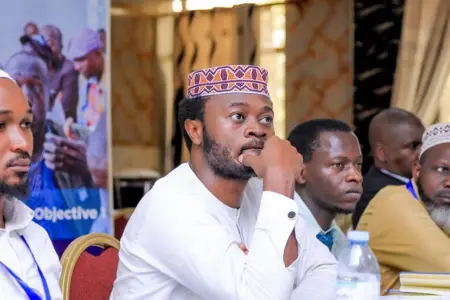
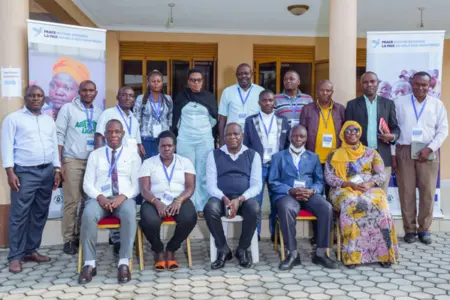
In December 2025, we held the first Uganda-DRC Cross-Border Exchange of a series of 3, with 40 participants, including representatives from local governments, security agencies, and civil society organizations.
0
5 radio drama episodes in Lukonzo.
0
7 radio programmes about recruitment prevention, reintegration of ex-combatants and the role of youth in P/CVE were aired across the DRC.
0

Milestone

First ever integrated Provincial P/CVE plan in North Kivu, DRC was adopted in March 2026.

Milestone

Local action plans for mainstreaming P/CVE were validated in Beni, Bunia and Irumu in the DRC, and in Kasese and Kampala in Uganda.

Milestone

In Uganda, the team produced a P/CVE Trainers Manual, a practical guide to empower local actors and integrate prevention into daily community life.

Milestone

New tenant registration form in Uganda, helping landlords improve identity verification and facilitate early warning prevention.

Objective 2: Building resilient communities

39 Salafi leaders in Uganda (Amirs, Amirats and professionals) trained on inclusive community leadership, governance, economic empowerment, and institutional development.
0

Milestone

A 10-year Community Development Strategy was jointly developed by participants in Uganda.

100 at-risk youth from Beni, Bunia, Irumu, and Mambasa trained by the Alternative University of Pole in P/CVE, civic education and citizen responsibility, and entrepreneurship skills.
0
In Kampala and Kasese (Uganda), 327 boda boda riders, transporters and landlords participated in tailored awareness-raising sessions focused on identifying recruitment tactics within the transport and housing sectors.
0
229 participants are now actively preventing and countering violent extremism.
0
17 trust-building activities were implemented between community members and institutional actors.
0

Objective 3: Supporting victims of violent extremism

82 victims of violent extremism received training on advocating for victims’ rights and organizational development for associations of victims in Kasindi, Irumu, Bunia and Mambasa.
0
National Victims Association established in Uganda with 47 members.
0
9 victims in charge of the National Victims Association in Uganda trained in victim-led advocacy.
0
2 dialogues were organized between host populations, local authorities and IDPs victims of ADF, in Bunia and in Kasindi-Lubiriha (Beni).
0
1 national roundtable with key institutions, including survivors of terrorism, government institutions, CSOs, the National Planning Authority, the National Counter-Terrorism, and the Uganda Red Cross Society.
0
100% of the participants reported increased understanding of victims’ needs.
0 %

Resources

Reports, tools and further reading

TitleContentLink
Salafi Community Development Strategy
Download
Peace Beyond Borders – Year 1 Review (2026)
Download
Peace Beyond Borders – Project Brief
Download
Minimum Practices for Mainstreaming Prevention/Countering of Violent Extremism (P/CVE) in our community
Download
Action plan for the minimum practices for mainstreaming prevention/countering violent extremism in our community
Download
Putting communities at the centre of preventing violent extremism
Download

Partners and funders

Who we work with

Partner

Pole Institute

Partner

Kofi Annan Foundation

Funded by

European Union

Partner with us

Talk to us about supporting or joining work like this.